2025 Year In Review

And yet again, here we are. I’m a sucker for investing arbitrary windows of time with extra meaning, so it’s time once again to look at the past 12 months and try to make some sense of what went down. Actually, scratch that. That puts too much pressure on the exercise. Instead, this is simply about trying to capture in a semi-coherent way, how some of my time and attention was spent in 2025. No promises of grand observations or deep realizations. Just a snapshot of what my 2025 looked and felt like.

Life and Work

The predominant happening in my work life in 2025 was the decision to leave The Ready at the end of October after spending a mostly happy decade there. The full story is longer and less interesting than you might think, but can most easily be summarized as “it was just time for a change.” If you read my seven year career retrospective article you can see some of the early ripples of discontent that coalesced into the decision I made this year. 

I’m still in the midst of navigating this change, as I did not have another job lined up when I went public with my decision to leave The Ready. I know my work will continue in the realm of organizational design and the broader intersection of personal and organizational development — but the specific shape it will take is still forming. I’m simultaneously exploring joining an organization to help them develop internal capacity for organizational design and change while also exploring shorter-term projects under the banner of my own company, Deliberate Works LLC.

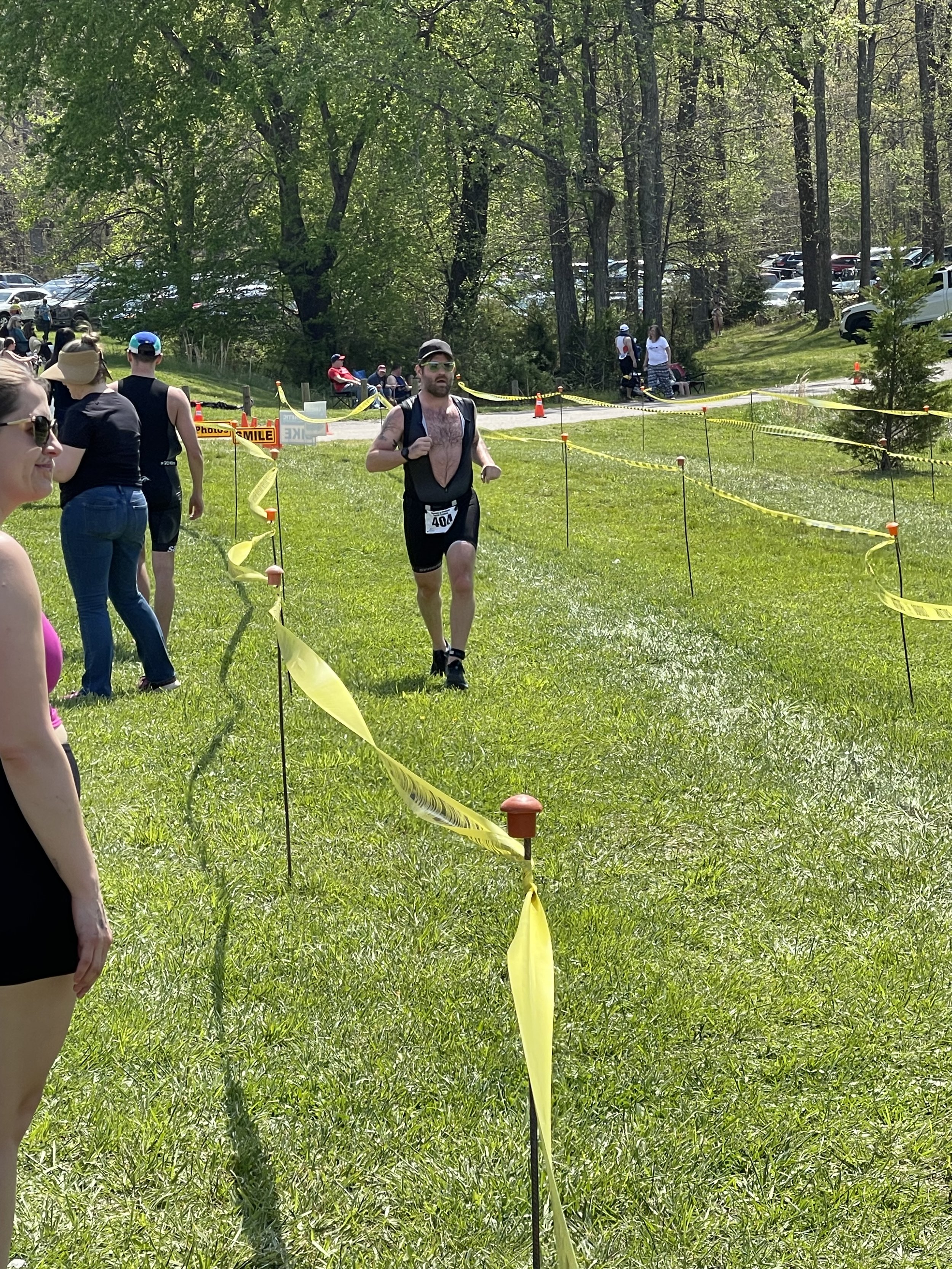
While the decision to leave The Ready was made in October, the whole year up to that point was marked by a higher than normal amount of stress. A casualty of that elevated stress level was my triathlon training. I had originally planned to do a local half-Ironman as my only race of 2025, but around July I made the decision to withdraw and abandon my dedicated training. What was supposed to be an outlet and stress-reduction activity had subtly turned into another job that I was doing poorly. I found myself getting behind the training plan which meant the predominant feeling after every training session was something like, “Ugh, I’m not where I should be.” I needed to remove stressors from my life, not add them, so I decided to put the triathlon-specific training on the shelf.

In its place, two new practices have re-emerged: walking and weightlifting. Most days I walk for 45-90 minutes and I’ve been lifting several times a week for the past couple months. It has been nice to let myself do (mostly) what I want to do rather than feel like I should be doing something extremely proscribed all the time. And, wouldn’t you know it, once the looming threat of a race I was unprepared for was removed from my calendar, I’ve found myself wanting to get back on the bike and put the running shoes back on (I can’t say I’ve been craving getting back into the water though…)

Somewhat surprisingly, I’m fairly certain that this relatively short but consistent time of lifting again has resulted in me being the strongest I ever have. I don’t have any records from my college days, but I don’t have any memory of having lifted what I’m currently lifting. Not much to write home about for most, but it has been gratifying to see all of those numbers gradually go up. 

As a bit of a replacement for my paused triathlon training, I devised a little project for myself I’m calling “FIT40” which is simply the intention to achieve a handful of objective strength, cardio, and health measures by the time I’m 40 (February 2027). I will likely write more about this in the coming year as I continue to refine those goals and how I intend to get as close to them as possible.

A quick grab-bag of additional events and moments from this year:

  • Getting more involved in the care of my nephew who was born with an extremely rare neuromuscular genetic disorder called RYR-1

  • Meeting another nephew who was born in February

  • Moved into a new apartment (down the hall from our previous apartment)

  • Travel to San Jose, Buffalo, Oakland, and Cape Cod for work and family reasons

  • Traveled to Ireland for a family wedding and short vacation

2025 was an extremely unsettled year when it comes to my professional life — but has ended on a high note with the optimism that comes with exploring new opportunities. Life-wise, 2025 continued to bless me with loving family and friends.

Reading

In 2025 I read 63 books across 23,138 pages. This is the most I’ve read since 2018 and the fourth most pages I’ve read since I started tracking in 2008. 71% of the books I read were non-fiction. I haven’t done the math, but I imagine it actually looks more like 60/40 non-fiction/fiction if you do the calculation via pages, because there were a few absolute fiction-chonkers this year (e.g. Wind and Truth, Anathem, and Crime and Punishment).

I don’t want to do a completely exhaustive retrospective on the year, so instead I’ll pull out a few notable observations and recommendations. My favorite non-fiction books from the past year were Things Become Other Things by Craig Mod, Apple in China by Patrick McGee and The Sirens’ Call by Chris Hayes. I can picture TBOT and The Sirens’ Call being books I re-read at some point in the future (in some ways, TBOT was already a re-read because I read the original fine art edition of the book Craig put out in 2023 when it was first published).

My favorite fiction from the year was The Etched City by K.J. Bishop, On the Calculation of Volume (Book 1) by Solvej Balle, and Anathem by Neal Stephenson. All three of these books grabbed me like little else ever has and were more or less complete surprises. I had very little expectations about any of these and all of them completely engrossed me.

18 of the 61 authors I read this year have written something I read in a previous year. That means I read 43 authors for the first time this year. A few authors showed up more than once this year: Solvej Balle (two), Cormac McCarthy (four), Tom Holland (two), Dan Jones (two), Katherine Addison (two). 

If I had to pull some themes out of this year, the following stand out:

  1. I’m interested in systems under strain: Across politics, technology, organizations, and the self, I keep returning to moments where systems drift, harden, or collapse — macro systems (Autocracy, Inc., Technofeudalism, Dominion, Apple in China, Who Is Government?, The Wars of the Roses), tech-mediated systems (Nexus, Enshittification, Superbloom, The Sirens’ Call, Extinction of Experience), organizational systems (The World Is Your Office, Leading into the Age of Wisdom, Bonfire Moment, How to DAO), or inner systems (The Burnout Society, The Anxious Generation, Meditations for Mortals, Zen Mind, Beginner’s Mind).

  2. I’m interested in attention, meaning, and limits: I’m obviously skeptical of the modern myth of infinite optimization. Meditations for Mortals, The Burnout Society, The Anxious Generation, Superbloom, The Sirens’ Call, Excellent Advice for Living all form a loose canon about attention as the scarce resource and limits as something to be designed with, not escaped. Even this year’s fiction echoes this: Invisible Cities, The Lathe of Heaven, On The Calculation of Volume Part 1 and Part 2, and the Border Trilogy by McCarthy all dwell on constraint, repetition, silence, or inevitability rather than progress narratives.

  3. I’m drawn to threshold moments: Many of this year’s books sit at edges: collapsing empires (McCarthy’s Border Trilogy, Young Men and Fire, The Wager), technological inflection points (Masters of Doom, Nexus), moral or metaphysical thresholds (Crime and Punishment, Arendt, Foucault, Dostoyevsky, Schopenhauer, Spinoza). What do people do when old maps stop working? How do character, structure, and belief interact when the rules no longer feel trustworthy?

Finally, I’ll say a few words about how I manage to read this much. I don’t offer this as any sort of judgment about how much you read (or didn’t) last year, but only because it’s the number one follow-up question people seem to have when I let slip the number of books I read in a year. Take what’s useful, discard the rest. 

First, a few structural realities/privileges that help me read a lot that may or may not apply to you: I don’t have children, I read fairly quickly, I mostly work from home, and I have access to many books via disposable income and a great local library. 

Moving into the more actionable patterns you might be able to do something with: 

  1. I always try to have one book going in each of the following formats; paper, digital (Kindle and/or Apple Books), and audiobook (Audible and/or Spotify and/or Libby). This means there’s very rarely a context where I can’t read because of a lack of access. I can (and do) read digital books on my phone. I will listen to audiobooks while I work out or drive (and don’t let anyone ever tell you that audiobooks don’t “count”). 

  2. This may seem counter to what I just said about having at least three books going at once, but I also try to limit the number of books I read at the same time. Usually not more than three, never more than 4 or 5. I will try to read these books as a pack — meaning I won’t let myself start a new book until I’ve finished the whole set of 3-5. That means sometimes I have to “make” myself finish the last one (usually the one I’ve been avoiding for some reason) in order to “unlock” the ability to refresh my stack. I hold this lightly which means sometimes I’ll immediately replace one I finish even if I’m still working on the others in the “set.” And sometimes not. 

  3. I think it’s helpful to have different “types” of books going at the same time so that if I don’t feel like reading one thing there’s a chance I’ll feel like reading something else (again, I’m aware of how this is at odds with the “limit WIP” pattern I describe in the previous paragraph). That might look something like having one “work” book, one classic literature, and one sci-fi. Or maybe two non-fictions about wildly different topics and one fiction. You get the idea. If something isn’t grabbing me at any moment in time I can always shift to something else. 

  4. It can be useful to think of part of your reading practice as “attention training.” That means I periodically try to read something I know I won’t understand or is “too hard.” It’s okay if I don’t understand it completely. I think it’s valuable to regularly sit down and put your attention on something difficult. I generally won’t read books like this back-to-back but at least a couple times a year I want to be a little bit intimidated by what I’m trying to read. I trust that this has value for my ability to focus beyond the specifics of any one book.

  5. Finally, my last pattern is to not stress out about it. I don’t read this much because I’m trying to hit some kind of arbitrary number. I read this much because this is how much I want to read. It’s my favorite entertainment activity and what I find myself drawn to whenever I have downtime. The end result is I typically read 50-60 books in a year. There have been seasons where I’ve read less than this and there may be future seasons where I read drastically less than this. I’m okay with it. Reading should be fun. Don’t stress yourself out over it.

Other Entertainment

TV

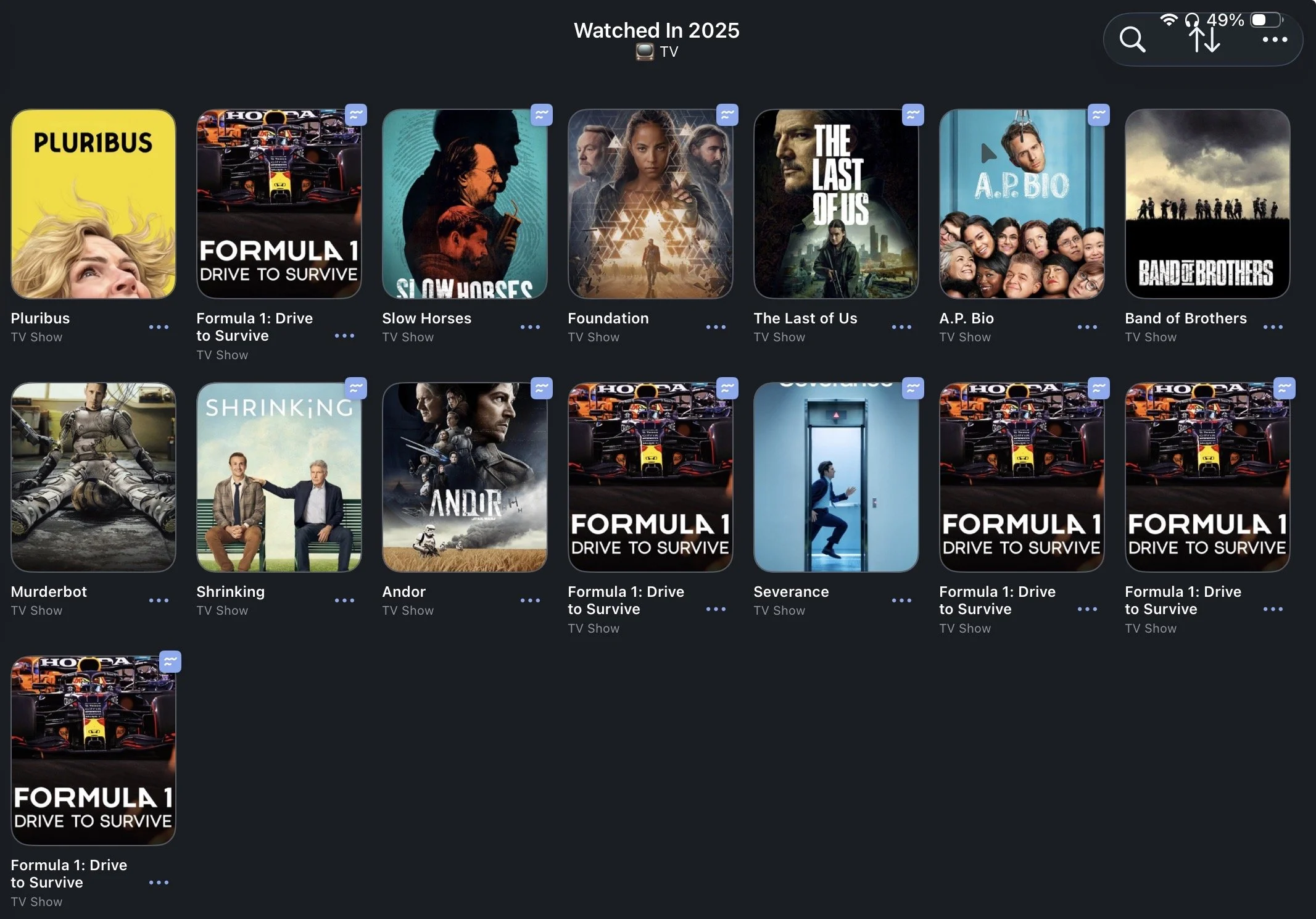
I watched 13 seasons of television across 9 shows this year. This is pretty similar to the amount of TV I watched in 2024. The only show I watched multiple seasons of was Drive to Survive, where I made it through the first five seasons of the show. Five shows were me watching the latest available seasons: Severance, Andor, Shrinking, Foundation, and Slow Horses. One season was a straight-up rewatch: Band of Brothers (Emily is on a military history kick and hadn’t seen it before). The new shows were Pluribus and Drive to Survive. I watched part of the first season of A.P. Bio but ended up dropping it after a few episodes.

When I look back at the year of TV I’m struck by how there’s SO MUCH great TV that I’m not watching, but want to. The stuff I did watch, though, was really good. Severance, Andor, Shrinking, Foundation, and Slow Horses were all excellent — with Andor probably being the single piece of video that made the biggest impact on me this year. 

Film

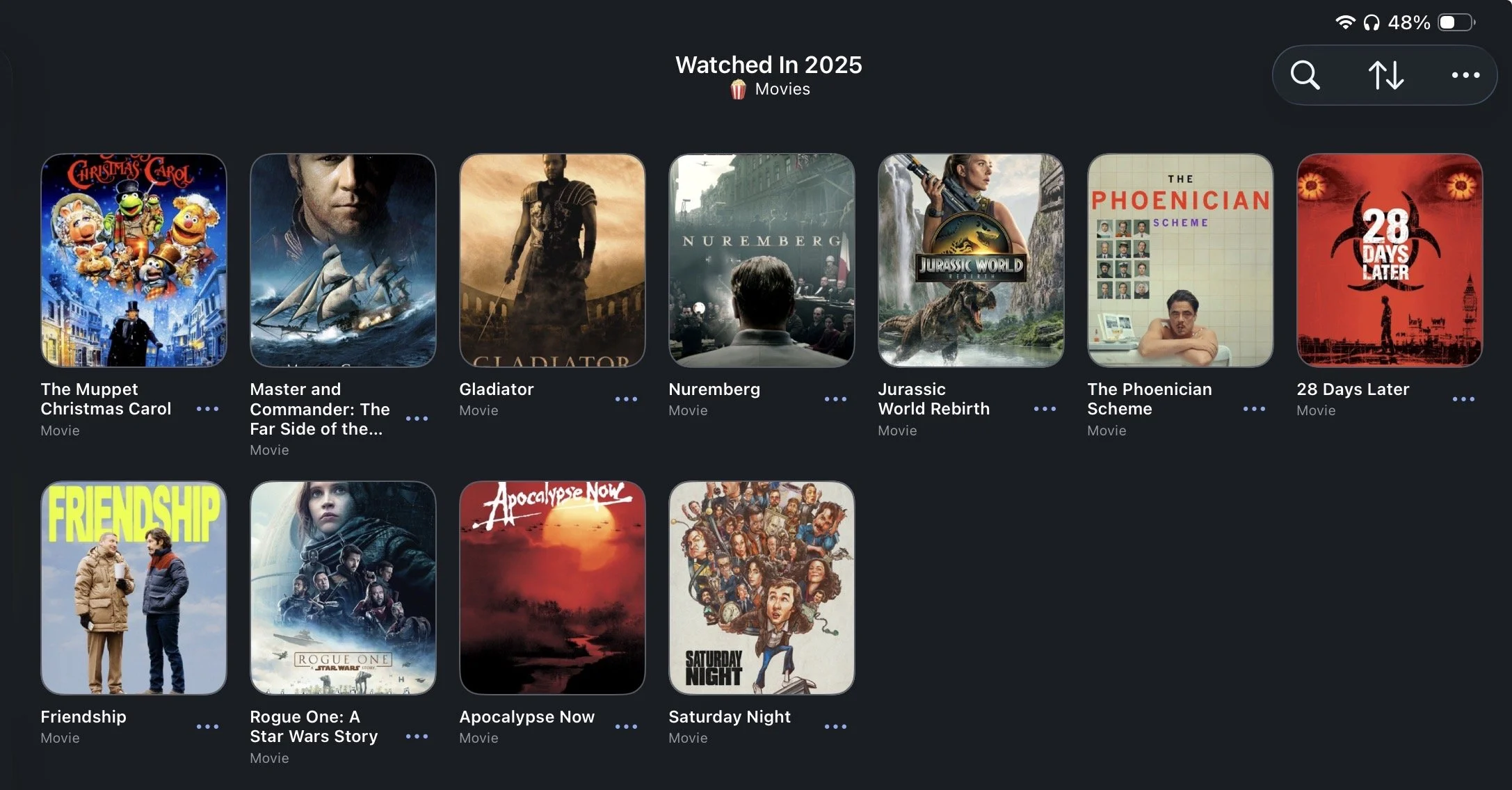
In 2025 I watched 12 movies, which is five more than I watched in 2024. I thought I was going to be on track for basically the same as 2024, but experienced a veritable onslaught of movie watching in the last two months of the year, with one in November and four in December. I mostly enjoyed everything I watched, with maybe The Phoenician Scheme being my least favorite. I think Wes Anderson figured out how to be too Wes Anderson. And yes, I’m naming it as more disappointing than Jurassic World: Rebirth because my expectations were non-existent for the dino movie and it actually mildly exceeded that exceedingly low bar!

We went on a semi-accidental Russel Crowe binge after really enjoying Nuremberg so we obviously had to follow it up with Gladiator and Master and Commander: The Far Side of the World

I watched Rogue One (a re-watch) immediately after finishing the last season of Andor and it felt like it added a bunch of emotional weight that wasn’t there the first time I watched it. My lovely wife is the reason we watched Apocalypse Now this year (a re-watch for me) because of the aforementioned military history kick she has been on.

Video Games

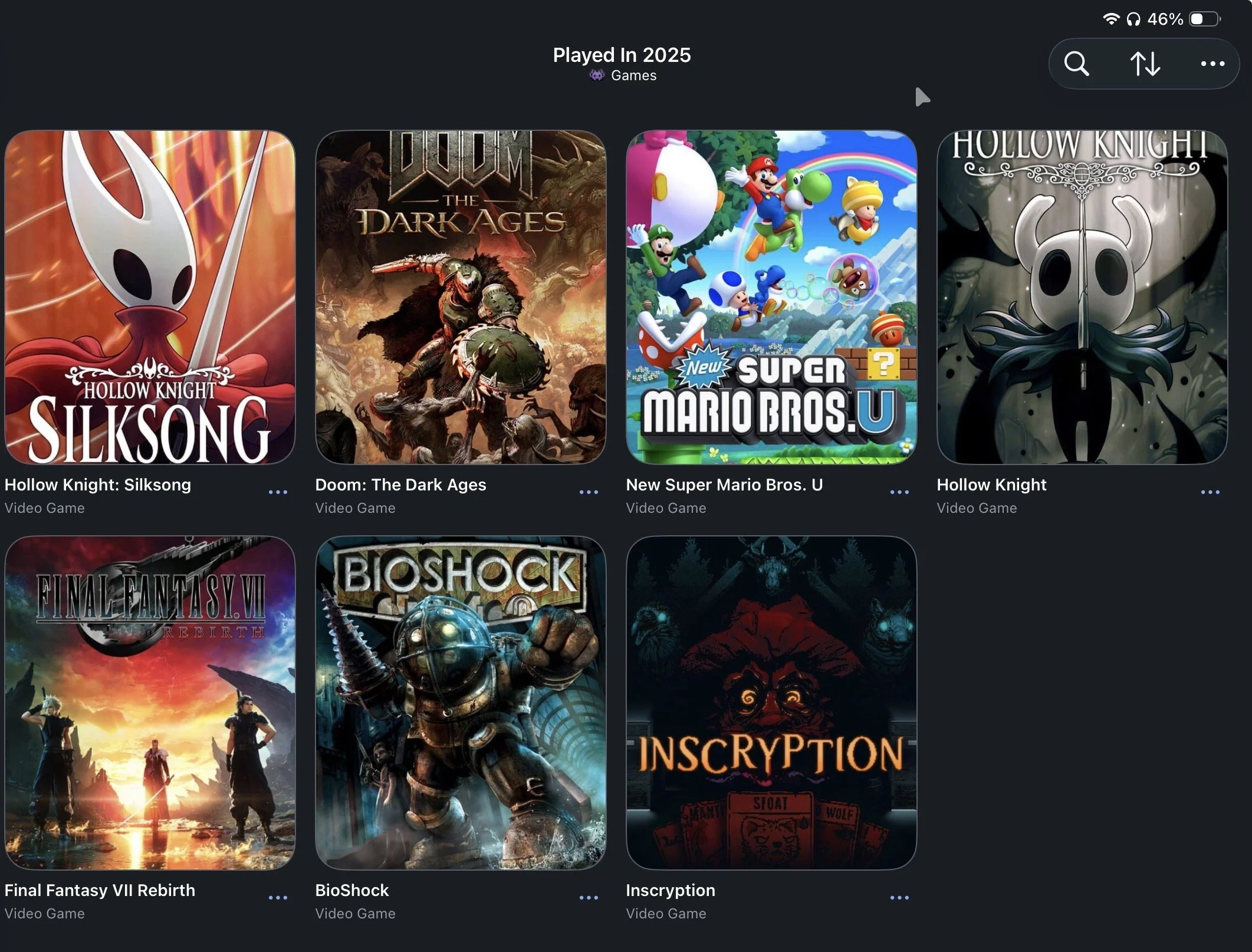
In 2025 I played seven video games for a substantial amount of time (at least a few hours) and beat five of them: Inscryption, Bioshock, Final Fantasy VII Rebirth, Hollow Knight, and Silksong. I would call both Hollow Knight and Silksong truly transcendent video game experiences. Both are now in my top five favorite games of all time and consistently evoked feelings of wonder, awe, and deep emotional resonance as I played them. Final Fantasy VII Rebirth was also surprisingly good, especially since it is a remake of my favorite video game of all time which can be fraught territory.

I really leaned into the idea of only playing one game at a time for the majority of the year. I’ve learned that the types of games I like to play really benefit from the familiarity and skill development inherent in not letting too much time elapse between play sessions (all you Hollow Knight and Silksong fans just said, “Yeah, no shit.”) I like games that require you to continuously improve your physical skill and that reward your ability to learn their worlds in a way that you can’t if you’re only playing them once every couple weeks. This is likely something I’ll carry into 2026, too.

Music

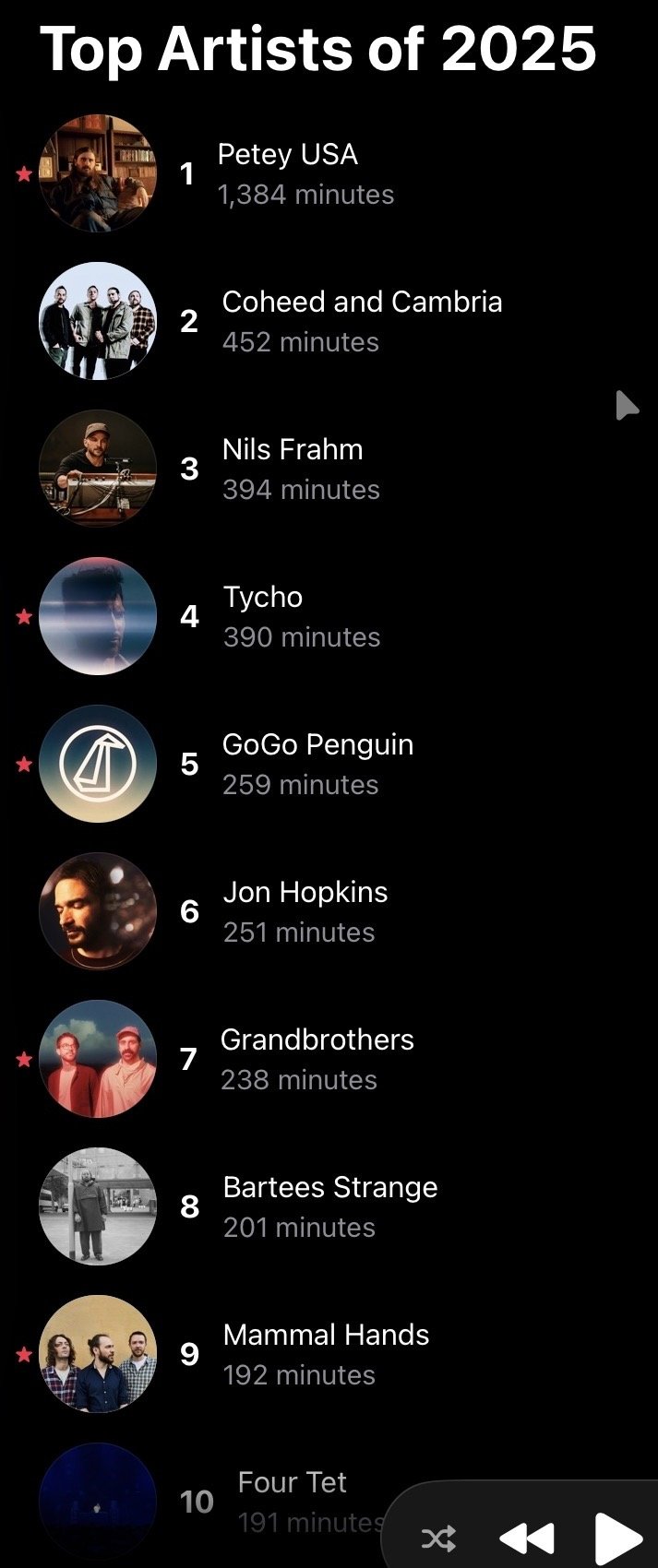
Music is almost always a tool for me. Meaning, I primarily listen to music while I’m working or writing. Which isn’t particularly conducive to really appreciating what it is I’m listening to. This is also why I sometimes don’t recognize a couple of my most played artists in my end of year streaming wrap-up because I spent most of my time listening to playlists I didn’t make. That being said, I can almost always count on Coheed and Cambria showing up somewhere in my top five, like they have for at least the last decade. And, in a repeat of 2024, Petey was once again my most listened to artist of the year. Can’t get enough of my angsty and absurd boy.

Other Entertainment

It was a light year for live entertainment and probably would’ve been even lighter if I wasn’t married because I was not the driving force behind either of these outings. I saw Nine Inch Nails live because Emily really wanted to. I really only know NIN via listening to the radio in the late 90s and early 00s, but the show was surprisingly good. 

And maybe my most memorable entertainment moment of the year, I saw the musical Titanique! with exactly zero foreknowledge about what it was. I knew the Titanic was involved… and that’s it. To say I was impressed and surprised would be a huge understatement. Highly recommended, would see again.

Does going to a book signing/author talk count as a live event? Let’s say yes, which means I can throw seeing Craig Mod in Beacon, NY with my brother into this category as well. His Things Become Other Things book was one of my favorites of the year and it was cool to share physical space with him for an evening.

Software & Hardware

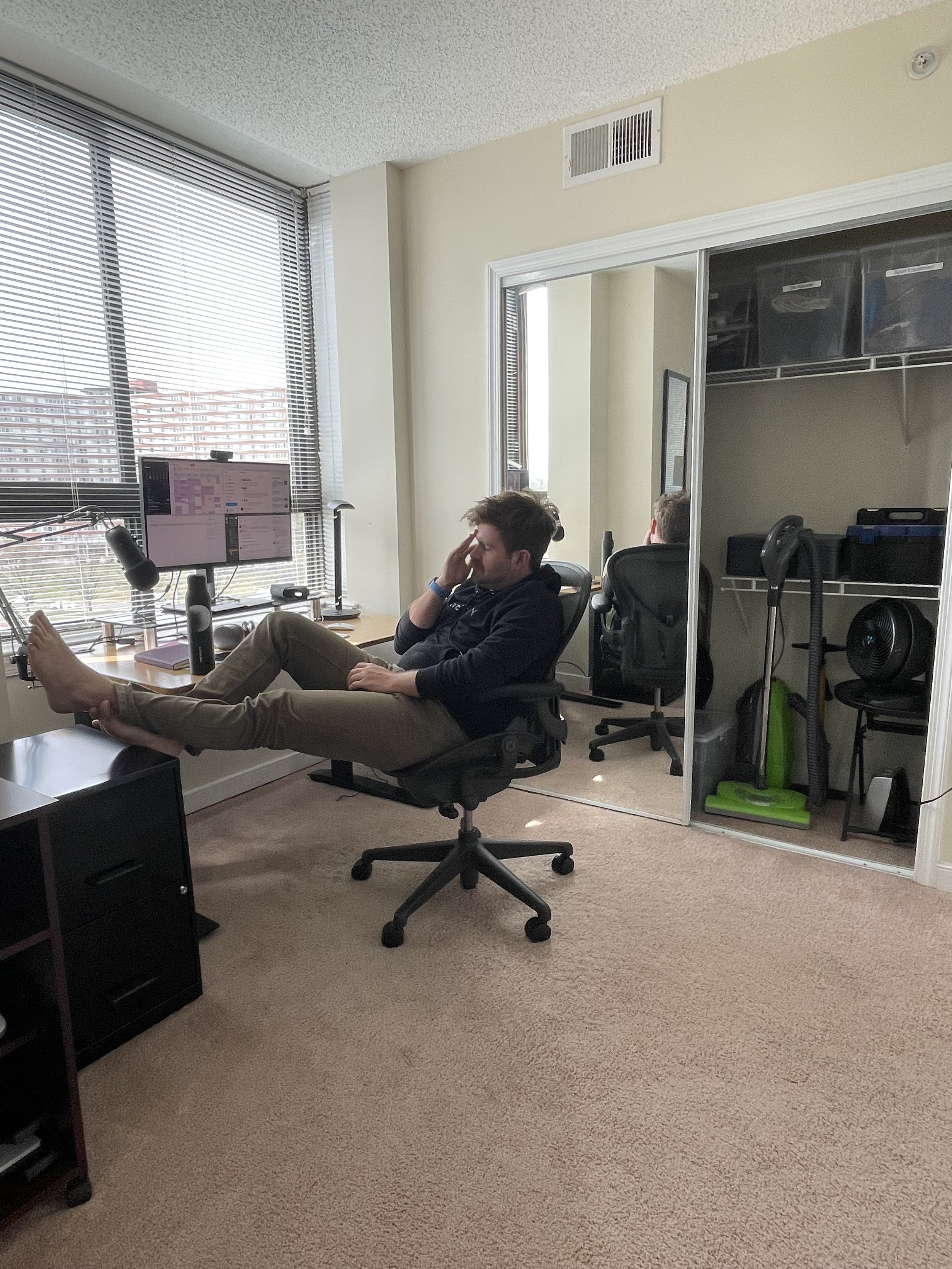
You could read my 2024 Hardware & Software review articles and they would be 95% accurate for what my 2025 consisted of, too. There were no notable changes to my hardware setup this year. I’m still rocking the same M3 MacBook Air, M4 iPad Pro, iPhone 15 Pro Max, old-ass HP monitor, older-ass Aeron Chair (that I did have to amputate the arms off of this year…), and everything else I listed in last year’s article. The only new things involve a slightly better webcam than what I had before (because Jack got tired of editing my janky video for At Work with The Ready), and some fancy Studio Neat Mark One pens.

I noticed some burn-in on my monitor for the first time a few weeks ago, so I’m wondering if that is a precursor to something more catastrophic happening sooner rather than later. I’m hoping it can hold on long enough until Apple updates their display product line. By the time next fall rolls around, I’ll be rocking a 3-year old phone so I would imagine a new one might be in the cards by then. It’s still chugging along just fine, though, so I’m gonna try to keep it going as long as is reasonably possible. 

Things are almost as static on the software side of the house, too. The major changes are casualties of no longer being employed at a company that expects me to use certain tools. I’m spending much less time in Slack, Notion, and Loom. Sadly, my Superhuman account expired shortly after my employment at The Ready ended and I can’t justify dropping hundreds of dollars on an email app, as much as I enjoy it. I’ve replaced it with Airmail for the time being, but have also used the default Mail app in its place.

The core of my productivity stack has remained the same, as it has for probably the last decade or so. Things, Fantastical, Bear, Ulysses, Day One, Overcastare still the apps I spend the most time in. ChatGPT remains my default LLM but I’ll occasionally dip into Perplexity or Gemini to compare/contrast. I’m switching back and forth between Arc and Safari as my mood dictates. I’ve tried most of the AI browsers for a hot minute and so far have not seen the light in terms of what they are bringing to the table.

I started using an app called Strong again to help me keep track of my weight training progress. I first used it many, many years ago and it is still really good. I’ve been pleasantly surprised how well it has been maintained and how easy to use yet full-featured it is. My favorite piece of new software this year is probably Monarch. I used to be a pretty deep user of Mint, back before Intuit bought it and destroyed it. I took the time to get fully set up into Monarch in the middle of the year and it has helped me get my arms around my finances in a way I didn’t really realize I was missing until I started using it. It’s a surprisingly delightful piece of software.

Conclusion

What should be gleaned from this year? A year that contained some of the most monumental changes I’ve experienced in years (leaving The Ready, stopping triathlon training) along with pure stability in others (hardware, software, how I allocate my entertainment attention). Perhaps the stability I seek in many aspects of my life is what gave me the foundation to have the clarity and confidence to make some of these large changes? Or perhaps I revert to familiarity when other aspects of my life feel out of control? In all likelihood, it’s probably a little of both and neither. 

Previous Yearly Review Articles

2024 Year in Review: Most of the Stuff I Own

This article turned into more of an overall audit of the physical things in my life rather than a specific look at what changed in 2024. It’ll be good to use as a touchstone in future years, I think. All links are non-referral and simply there for your convenience.

Tech and Work

I was fortunate enough to have a few significant upgrades in my most frequently used hardware this year. I was eligible to upgrade my work laptop and went from a M1 MacBook Air to a M3 MacBook Air. I stayed at the 13-inch size because it’s mostly closed and connected to an external monitor when I’m at home and when I’m traveling I want it to be as small as possible.

I used a big chunk of our credit card points to get a new M4 iPad Pro 12-inch with cellular, a Magic Keyboard, and Magic Pencil. This is the first “normal” sized (i.e. non-Mini) iPad I’ve owned in a few years and I’m using it as my personal device since I’m trying to create more of a firewall between my work device (the MacBook Air) and my personal devices (the iPad Pro). I ended up trading in my refurbished iPad Mini earlier this year because I found it frustrating to use because it had such little storage and its performance seemed strangely bad compared to what I was expecting. I’m loving having a powerful device with a cellular modem. There’s something really liberating about not needing to hunt for wi-fi when out and about.

Other than the computer, there are no significant changes to what sits on or near my desk. I still look at a 27” 4K Z27 HP monitor all day every day and the same Logitech BRIO webcam sits on top of it. I still use a Magic Keyboard and Magic Mouse as my primary peripherals when I’m sitting at my desk. I still have a Shure MV7+ USB mic on a boom and an Elgato key lightto make me look and sound good on podcasts and video calls. No changes to my nearly decade-old Fully Jarvis sit/stand desk or Herman Miller Aeron chair despite moving this year. If I wasn’t on a podcast I’d be able to massively simplify this desk setup. I think this is as simple as I can make it while still being able to record the quality of audio and video we need for At Work with The Ready.

At the end of 2023 I bought a set of AudioEngine A2 desk speakers because I got tired of trying to use my original HomePods as computer speakers. The HomePods are still in my office but are mostly just there to fail at my verbal Siri requests instead of failing at playing audio from my computer.

I didn’t upgrade my phone this year so I’m still rocking a case-less and mildly cracked iPhone 15 Pro Max. No changes to my daily headphones, AirPods Pro. The AirPods Max are still hanging around but mostly only get used as airplane headphones when they aren’t hanging from a hook under my desk. My daily (and training) watch continues to be the Apple Watch Ultra 2 with cellular.

This year I re-discovered the joy of index cards. I keep a stack of them on my desk and just whip through them any time I feel the need to jot something down or keep my hands busy during a meeting. I have the same brass pen on my desk that I’ve had for years. It’s hefty, takes Pilot G2 refills, and feels great in my hand. I do almost everything digitally nowadays, so I think I’ve been on the same medium, hardcover Moleskine notebook since the end of 2022. It stays on my monitor riser during the day and I make sure to always have it with me when I travel.

Entertainment

Entertainment hardware basically stayed the same except for one extremely significant exception: a new TV. I took advantage of a good Black Friday sale to pull the trigger on a 65” Sony BRAVIA XR A95L OLED TV to replace the 55” TCL we had since early 2018. It’s still early days but it seems like a remarkable piece of hardware.

Everything connected to it, a Sonos Playbase, two Sonos Play 1s, PlayStation 5, Nintendo Switch, and Apple TV 4K remain unchanged.

There was actually another TV purchase made this year, but it was much less exciting. In an effort to spruce up my indoor riding situation (as mentioned in my 2024 in Review: Training article), I got a cheap 32” Samsung and put it on a rolling cart with another Apple TV 4K as my dedicated Zwift machine. It is helping to make indoor riding slightly more bearable.

I’m still rocking two original HomePods in my office and two HomePod minis (one in the bedroom and one in the kitchen). They are primarily used for getting frustrated with Siri and sometimes playing very nice audio.

I still do most of my non-iPad or non-iPhone digital reading on a Kindle Paperwhite.

Training

2024 marked my third full year of training for triathlons and the vast majority of my equipment has remained unchanged from the original equipping I did in the summer of 2021. I’m still rocking the same mystery year, Craigslist-attained, Trek Madone road bike with aftermarket aerobars, a Garmin Edge 530 head unit, and Garmin Forerunner 745 watch. The watch, somewhat interestingly though, has mostly lived in a drawer as I’ve learned I can use my Apple Watch Ultra 2 as my everyday watch and training watch. I even wore it during my half Ironman race this year and it had plenty of battery to get through the whole 6+ hour race. The other piece of kit that has mostly lived in a drawer this year is my Apple PowerBeats Pro headphones. These are my go-to headphones to wear when riding outside because it’s impossible for them to fall off but I’ve done much less of that this year. Riding indoors, running indoors or outdoors, and strength training all happen with my AirPods Pro.

I still do the vast majority of my running in On Cloudmonsters. I wear Pudolla running shorts, Amazon Basics tech t-shirts, and the running hats given as part of participating Ironman Michigan 70.3 the past two years. I’ve got Baleaf swim jammers, a Speedo pull buoy, some Omid goggles, and Speedo swim caps. I actually have two pairs of flippers because I thought my original pair didn’t make the move from Arlington, but apparently they did. I have the same basic Shimano cycling shoes I’ve had since the beginning. My Saris bike rack for my car continues to be a stalwart (it was stolen off my car in 2023 and I re-purchased the exact same model).

As mentioned in the previous section, I upgraded my indoor riding room by getting a TV and an Apple TV 4K to give me a better setup for using Zwift. Another part of that upgrade was replacing my Kickr Snap with a Kickr Core. I also bought an Amazon Basics weight bench to keep in that room and it primarily serves as a table for my nutrition during long rides. A generic music stand does a good job of holding my iPad and phone within arm’s reach while I’m riding.

A few other fun upgrades this year was getting a Giro Aerohead MIPS racing helmet and a new Cannondale Topstone gravel bike. I live within easy riding distance of an approximately 9 mile gravel trail that tracks along the Hudson River so I wanted to get something that would let me ride it, especially since I’m pretty sketched out about riding on the roads around me. I also picked up some On carbon-plated shoes to wear during my race, but I got cold feet about actually wearing them for my half Ironman this year since I hadn’t yet done a long run in them. They will be waiting for me next year, though. I don’t think I’d call a new heart rate monitor a fun purchase, but I did have to replace my original Garmin this year and I decided to go with a Wahoo Tickr. My racing kit — one of the development team fundraiser options from That Triathlon Life — was new this year and made me feel faster than I am. My second pair Goodr sunglasses finally de-laminated so badly I couldn’t see out of them any more, so I got a pair of Tifosi’s for my outdoor cycling needs.

Kitchen

No major changes in kitchen kit this year. I remain the primary chef for our family and more or less have everything I need to handle cooking for us.

Starting in roughly chronological order of when I interact with these tools, my coffee setup remains anchored by my Fellow grinder and electric kettle. I get my beans delivered on a schedule from Trade Coffee (use this referral link if you check it out and I’ll get some free coffee) and generally alternate between AeroPress and pour overs, depending on my mood. I have a multi-cup Chemex that I don’t think I used once in the past year, but keep handy for any situation where I need to make coffee for more than just me. There’s also an espresso machine Emily gave me last Christmas, but it’s more for afternoon snacks. In the morning, I’m a simple pour over or AeroPress guy. The Eufy handheld vacuum stays right next to the grinder and kettle and is extremely necessary for cleaning up my coffee grinding mess.

Our Aarke water carbonator gets a lot of work and we keep it supplied with CO2 via a subscription from SodaSense. Our KitchenAid stand mixer is always ready for me to whip up some bread dough or cookies. Our Breville 650XL toaster oven is a total champ (thanks to John Siracusa for the recommendation). Our Vitamix remained underused this year, as Emily has seemingly moved on from her smoothie phase and I keep thinking about making soup in it and then not doing so.

A Belkin charging stand lets us use our phones in Standby Mode while we’re doing things in the kitchen. Our Frigidaire dehumidifier makes sure the apartment isn’t getting weirdly humid. There’s a pizza stone living in the oven — ensuring we’re always ready to make some bread or a pizza. Deli containers are our go-to leftover containers of choice and my Zojirushi travel mug is always standing by waiting to keep my coffee hot for an unnaturally long time.

My knives aren’t particularly noteworthy, other than the fact that I try to keep them all extremely sharp with a nice whetstone session every couple months or so.

Clothing

Some expensive shoe purchases over the past few years are coming to fruition this year in the fact that other than some new running shoes, I didn’t have to buy any other shoes this year. I’m still rocking Wolverine boots from 2018, Rothy’s sneakers from 2022, Velasca sneakers from 2020, Velasca dress shoes from 2021, Teva flip-flops from 2018, Glerups from 2021, and some brown BEDSTU shoes from at least 2018. I was tired of buying shoes that fell apart after a year and were impossible to repair.

I don’t generally think about my clothes very often because I tend to wear the same thing over and over, but this year did result in me changing two staples pretty significantly. After many years of wearing Everlane t-shirts, I got frustrated with their worsening quality and decided to find a new default shirt. I landed on Uniqlo for awhile, but they were somehow too nice? At least, they were too thick. I then stumbled across the Comfort Colors brand in some random article and they’ve become my new default shirt. Cheap and soft and pretty nice fitting.

I went on a similar journey for new socks after wanting to move on from the Everlane/Aasics combination I had been rocking for the past few years. I ended up going with Darn Tough in two different varieties: ankle socks and mid-calf socks. I’m learning to quiet the Millennial voice that yells at me every time I wear socks that extend beyond my ankles.

I had to get some new sunglasses this year after breaking my previous pair and decided to go with some custom RayBan Wayfarers (got them with orange arms and blue frames, which looks good with my orange strapped Apple Watch Ultra 2).

Odds and Ends

A few other significant additions this year include a new Roomba i3+ EVO robot vacuum and a (new to us, but used) 2014 Subaru Forester. When we moved to New York we needed a second car since Emily commutes to an office every day in our 2020 Toyota Camry. I bought a ridiculously expensive, but really good, phone mount for the Forester and now it’s basically perfect for what I need it to do.

A few old stalwarts worth mentioning include maybe the oldest piece of tech I own, a Coway air purifier from 2016 that lives in our bedroom. My Wahl beard trimmer is also still going strong from 2017.

Looking Ahead

Despite this being the longest article in my 2024 Year in Review series, I didn’t actually buy many new physical items this year. I’d definitely like to keep that trend going in 2025. Moving has a way of really clarifying how much stuff you have in a really visceral and annoying way, so even though we don’t have any imminent plans to move again, there’s definitely a non-zero chance we could move again sooner rather than later and I’d love to not live in fear of that possibility more than I have to.

2024 Year in Review: Entertainment

Reading is my primary mode of entertainment, and there’s a whole separate article for that. This is the article where I combine all other forms of entertainment and look back at what I consumed in the past year.

Video Games

It’s funny, I self-identify as a “gamer” and spent most of my childhood pining for the games and consoles I couldn’t afford, but I actually played objectively few video games this year. The only game I fully completed was Final Fantasy XVI, but I played the bulk of it in 2023, only putting the finishing touches on it in 2024. I haven’t touched the DLC, yet, but I plan to. Continuing the Final Fantasy theme, the game that consumed the majority of my playing time this year was Final Fantasy VII: Rebirth. It’s a marvel of a game, truly. The original Final Fantasy VII is my favorite game of all time, searing itself deep into my childhood and teenage subconscious. Somehow, they’ve created a game that has honored that hyper-nostalgia without just making a frame by frame remake. I’m enjoying it. Haven’t finished it yet, but hopefully in the first half of 2025.

As far as additional console gaming goes, I played some Helldivers 2, Hollow Knight, and Inscryption. Playing games with strangers stresses me out, so Helldivers 2 ended up on the shelf pretty quickly. I started scratching the surface of the beauty and stellar reputation of Hollow Knight, but hit a couple of spots that demoralized me so completely I put it down to take a break, and then several months had elapsed. I only started playing Inscryption in October, and I’ve liked it quite a bit.

Outside my PlayStation, I’ve dabbled in Finity, Vampire Survivors, and Balatro on my iPhone, with Balatro taking the majority of my attention there.

Music

Music is almost always a productivity tool. I turn it on when I need to focus, which means I listen to almost exclusively instrumental tunes. I also rarely listen to albums, choosing to stick to playlists like Apple’s Chill, Focus, Lo-Fi Japan, Living in the Library and other downtempo/electronic playlists. Tycho is the epitome of the music I’m looking for when working, and there was actually a new Tycho album, Infinite Health, this year that I found myself listening to on repeat for a while.

Other than music-as-focus-tool, my big discovery this year was Petey. I got obsessed. In a true sign of the times, I first became aware of Petey because of his absurd sketches on Instagram. I then heard his music referenced by the triathlon podcast I listen to, so I decided to give him a try. Oh man, it scratches the same itch that Manchester Orchestra and Say Anything and Modest Mouse do for me. Plus, he has connections to Michigan (gotta appreciate any time someone wears a Detroit Vipers jersey). It’s rare when I find a new artist (to me) and they almost immediately pop into my top five favorite artists list, but Petey did it.

Honorable mentions have to go out to everyone’s favorite German partycore band, Electric Callboy, who I continue to adore and their collaboration with Babymetalthis year is a delight. I started to dabble into some seriously heavy stuff like Lorna Shore thanks to my strange obsession with watching drummer YouTube videos as a non-drummer (shout out to Drumeo, for that). Sometimes you just wanna listen to some insanely talented musicians shred and growl like demons, you know?

Oh, and my favorite band of all time, Coheed and Cambria, has been releasing some new singles (and a whole album of covers), so you know that has me looking excitedly toward 2025.

Movies

Boy, I certainly don’t watch many movies, eh? I watched a grand total of 7 this year. Godzilla Minus One, Perfect Days, Gettysburg, and Dune: Part Two fwere great. Furiosa: A Mad Max Saga was okay. Napoleon and The Creator were bad.

TV

I watch only slightly more TV than I do movies, but the overall hit rate on what I watched this year was much higher than past years. The entire run of Detroiters (S1 & S2), Shoresy (S1-3), The Last of Us (S1) and Slow Horses (S1-S3) were incredible. Fallout, 3 Body Problem, Faceoff: Inside the NHL, and Planet Earth III were pretty okay. Not a fan of The Mandalorian and don’t think I’ll be moving beyond the first season.

I’ve also come to enjoy Dropout TV, particularly the show Very Important People. Two comedians sit down for an improvised interview after one of them receives an elaborate makeover and has to make up a character to go along with it. Some episodes are whiffs, but the ones that hit, hit hard.

There are a few YouTube channels where I generally watch every new video: the boat building-turned-boat-sailing channel, the long-haul hiker who posts daily recaps, the aesthetic triathlon channel and the unhinged but motivating triathlon channel, and a couple of hockey recap and analysis channels.

Podcasts

The champion of 2024 was, by far, The Rest Is History. After hearing people praise it, I finally went face down in it this year. It’s incredible and maybe my new favorite podcast.

I’m not a huge 99% Invisible fan, but their yearlong read along of Robert Caro’s The Power Broker with Elliot Kalan from The Flop House was great. They had some great guests, including what felt like out of nowhere, Brennan Lee Mulligan from Dropout.

The current full roster as of December 31st, 2024 is: The Rest is History, Accidental Tech Podcast, Philosophize This!, 32 Thoughts, Upgrade, Reconcilable Differences, Dan Carlin’s Hardcore History, Dithering, Sharp Tech, Sharp China, In Our Time, Coretex, Navel Gazing, Robot or Not?, Roderick on the Line, The Talk Show with John Gruber, That Triathlon Life Podcast, Under the Radar, The Vergecast.

And I’d be remiss if I didn’t mention the podcast I co-host, At Work with The Ready, even though I have trouble listening to it since I put so much time and attention into making it.

Other Entertainment

2024 was a weirdly sporty year for me. I got into F1 thanks to finally cratering to peer pressure (many years later) on Drive to Survive. I picked up the F1 season about halfway through the summer and watched every race from there until the end of the season, developing the appropriately strong opinions about things I barely understand along the way.

Early in 2024 the extremely mediocre Detroit Red Wings, my favorite team of my favorite sport, went on a bit of a run at the end of the season and almost made the playoffs for the first time in the better part of a decade. Alas, they did not. But it was exciting for a while. Don’t talk to me about this season, though.

Similarly, the Detroit Tigers went on a perhaps even more improbable run at the end of last season, did make the playoffs, and got closer to making the World Series than anybody expected.

And just to round out my sporty year, the Detroit Lions are finally good and after years of heartbreak and then mostly ignoring them, I’ve tried to watch the vast majority of their games this season.

2024 Year in Review: Software

I care about the software I use. It should be fast. It should be well-designed. It should have a clear business model (as a predictor of longevity). If all of these things can be accomplished while also being developed by the first party (i.e. Apple), that’s even better.

Communication

Superhuman remains my email client across all devices. It’s ultra fast and allows me to use keyboard shortcuts without modifier keys (i.e. just hitting “E” to archive a message, hitting “C” to start a new email, etc.). That being said, I did spend some time with Apple’s Mail apps this year with very little interruption to my workflows. I don’t like the Archive Message keyboard shortcut on macOS and I have no need for the new Apple Intelligence automatic categorization features, but I do find its design to be otherwise clean and attractive. I’ll be sticking with Superhuman for the time being but if I ever got into a situation where I (rather than my company) had to pay for it then I’m pretty sure I’d bail to Apple Mail and not feel any worse for wear.

The Ready continues to use Slack for all our internal text-based communication even though I feel like I can see it deteriorating. I can’t remember a new feature they’ve introduced that actually useful. It’s getting more complex and worse every day.

We continue to use Zoom as the default video calling service at The Ready and most days I don’t really need to think about it, which is high-praise for a video calling platform. I find myself occasionally using Webex, Teams, or whatever the Google equivalent is called this week when certain clients call for it, and they all feel worse than Zoom.

Loom continues to hang around as a quick and useful way to make and share videos with each other at The Ready and with clients. It has become a mainstay in my asynchronous ways of working toolbox.

Personal text-based communication happens almost entirely in Messages.

Haven’t touched Audio Hijack in over a year but that’s more a function of “Fields of Work” being on hiatus and me not being involved in the production of “At Work with The Ready” (where we use ZenCastr).

Project Management

All my work continues to flow through Things. Emails that represent tasks get forwarded to Things, stray thoughts get captured into Things, next actions from meetings get extracted into Things — basically, anything that needs to become some sort of productive action on my part probably went through Things at some point. I periodically try replacing it with Reminders and it always feels like I’m trying to run through mud. Other than being blazing fast and having rock solid sync between my devices, the key feature that Reminders doesn’t have that Things does is the ability to “defer” a task or project until a certain date (basically, make it disappear from my system until a certain date). I use this all the time to help me focus on the stuff I can only do right now vs. the stuff I know I want to handle in the future.

The slight wrinkle to my Things-based utopia is that I have to work with other people and Things remains a resolutely single player app. The Ready uses Notion for project and knowledge management, so I have several different team-based kanban boards that I’m regularly monitoring and using. I will often manually extract tasks from Notion into Things but that sometimes gets unwieldy. If I could have my various Notion kanban boards automatically stay in sync with Things (and vice versa) I would be in heaven, but I don’t think that’s possible.

I’m no longer on any projects where we use Trello as our shared project management software.

I continue to use Fantastical with a Google Calendar backend. I’m an incredibly heavy user of my calendars because not only do I use them to keep track of upcoming appointments, I turn them into fairly accurate historical archives of what I was working on throughout the day. I experiment with the native Calendar app from time to time and I think I could probably make do if Fantastical disappeared one day. The one feature I’d miss the most, though, would be the ability to hide an event. I have a couple active calendars that are basically information radiators and once an event goes by or I have the information I need in my head I no longer want to see the information but don’t have the ability to delete it.

Reminders continues to hold a handful of recurring reminders I call Life Scaffolding as well as a shared grocery list that I collaborate on with my wife. It also is where I’ll throw any short-term reminders via Siri.

Documents, Decks, and Deliverables

Despite using Notion, The Ready still relies heavily on Google Docs, too. That’s where most of my document creation happens as I haven’t found anything where multiplayer collaboration happens smoother. We use Pitch for collaborating on most decks in real time. We use Mural for collaborating on a virtual canvas in real time (with occasional sojourns into Miro for a couple of client projects this year). I have small gripes with most of these tools but most days they feel pretty smooth and get the job done.

A lot of my early thought gathering happens in the notes app Bear. From there, that text may get shuttled over to a Google Doc or an email or a Pitch deck. I like how it looks and feels and how it handles Markdown. If I’m writing something, it’ll probably start in Bear and it may even stay in there for the duration of a project. If a piece of information is what I’d call a “Reference” it probably lives in Notes, though. For a long time it felt like I had to use Bear or Notes, but not both. I realized there are reference notes I look at pretty regularly (e.g. Weekly Review Checklist, Gift Ideas, hours the pool is open at my gym, the menu for the restaurant I order lunch from frequently) but don’t want cluttering up the space where I’m doing active work. I moved those things to Notes which allowed Bear to be an “active working space” for writing. So far, that distinction has felt pretty good.

Of course, it couldn’t be that simple, as I’m actually writing this in Ulysses. Why not Bear? Bear is for notes whereas Ulysses is where I write longer things that are destined to be articles or newsletter issues. That distinction feels useful in my brain, so I’m rolling with it.

And what about Obsidian? Obsidian is where I try to build an active “knowledge garden” with notes from the books I read, articles I write, and other pieces of knowledge building activities. I guess Notes is where I keep “life reference” material whereas Obsidian is where I keep “knowledge reference” material. It’s a quasi-Zettelkasten but if I’m being honest with myself, I’m not particularly stoked on how I’ve used/nurtured it over the last year but I’m not ready to pull the plug on it entirely.

Browsing and General Internet Things

I spent the vast majority of this year using Arc as my macOS browser. There are lots of things about it that I really enjoy (particularly the sidebar history and ability to put things in a split screen view). A couple weeks ago, though, I switched back to Safari and tried to invest a little bit of time in learning some of the “new” features that I never bothered to learn when they first came out. Web browsing feels like the number one thing to try to keep first party if at all possible. I’m not sure why, but it feels so central to the experience of using my devices I like when I’m able to use Safari across all of them. So, for now, that’s what I’m doing even though I remain a fan of Arc.

I can only go so far with Safari, though. I know it has a read later service built into it (Reading List), but as much as I try to use it I can’t make it stick for me. For 99% of this year I’ve used Matter as my read later service. I’ve been a big fan of Matter for a few years now but just recently started feeling like it’s trying to do too much. I noticed it was actually too good at surfacing other things to read that it thought I might enjoy (it was often right). I’d open the app to read an article I had saved only to be distracted by a bunch of other stuff. In the last couple weeks I re-installed my first read later love, Instapaper, and am going to try using it instead of Matter. I’m guessing its simpler design and less audacious aims might actually result in me reading more.

I’ve tried to get back into using RSS a bit more this year and have used NetNewsWire across all my devices to do so. I don’t remember why I switched from Unread.

ChatGPT (and to a lesser extent Claude and Perplexity) have grown in how much I rely on them throughout the day. I’d say I interact with ChatGPT basically every day. For awhile, I had it mapped to the Action Button on my iPhone so I could invoke it as quickly as possible, too. I’m pretty sure this whole family of apps, particularly ChatGPT, is going to continue gaining in importance for me across 2025 and beyond.

When I left Twitter a few years ago I thought I had maybe excised social media from my life permanently. With the growth of Threads and Bluesky this year, though, I’ve found myself getting pulled back into this world a little bit. I don’t post much on either one, yet, but both have a way of capturing my attention more than I’d prefer. I think Bluesky will become the place where I post more consistently in 2025 and I’ll probably continue to look at both more than I want.

Entertainment

Overcast is the only way I listen to podcasts. If it disappeared tomorrow I guess I could make the Podcasts app work, but there’s so many quality of life features built into Overcast I would miss.

Apple Music has emerged as my default music streaming service. It feels like one of those services where it has advantages over third party apps (e.g. Spotify) in how it interacts with the OS. While its algorithmic recommendations are definitely worse than Spotify there are aspects of its design I like much better. I’m also utterly uninterested in audiobooks or podcasts in Spotify and it feels like they continue to junk up their app with everything other than music.

Audible is where my audiobook listening happens. It’s fine.

I split my digital books between Apple Books (40%) and Kindle (60%). I wish I had one unified digital library but it feels like that ship sailed a long time ago.

I continue to do my sporadic personal journaling in Day One.

Logging what I play, read, and watch happens in Sofa (as well as managing the backlogs for each). I continue logging my reading in Goodreads mostly out of inertia.

Utilities

Weather nerdery continues in Carrot. Travel nerdery continues in Flighty. Training nerdery continues in TrainingPeaks and Strava. Password management is getting annoyingly split between 1Password and the new native Passwords app. Backblaze continues to silently back up my computer. Mela handles the handful of recipes I find myself referring to periodically. Rocket continues to help me put emoji everywhere and anywhere. Magnet got bumped out because macOS gained the ability to snap windows.

2024 Year in Review: Reading

I love reading.

It’s by far my preferred relaxation activity and my favorite entertainment medium. Most mornings I spend at least thirty minutes, often more like an hour, sitting in my living room with a cup of coffee and a book. I’ll occasionally finish my day with a book, too, but that’s a bit rarer. The vast majority of the books I read are digital, with maybe a 60/40 split of those between Kindle (primarily on a Kindle Paperwhite) and Apple Books (primarily on my 11” iPad Pro or iPhone 15 Pro Max). This year was skewed heavier toward Apple Books than usual. I always have one audiobook (via Audible) going at all times so I can keep reading even when in conditions where it’s difficult or impossible to read with my eyes. I also usually have one hard copy book in the mix, too. Sometimes I just want to feel those pages between my fingers, you know?

I’m not particularly precious about choosing what to read. I do maintain a backlog in the app Sofa, but I’d say I grab my next book out of there only 50% of the time. The other 50% of the time I either have something specific in mind I want to read or I’ll let the algorithmic recommendations in the Apple Books or Kindle stores put something in front of me. I tell myself I only read one book at a time, but as I’ve already described, I typically have at least one digital book, one audiobook, and one paper book all going at the same time. To not let something linger for too long, though, I try to finish reading the whole “batch” of three before starting anything new. This year I also actually managed to abandon a couple of books I wasn’t feeling. I’ve always been an inveterate “finisher” but I’m turning a new leaf (page?), apparently.

By the numbers, 2024 is a bit down from 2023. I finished 46 books (compared to 61 in 2023) across 17,335 pages (down from 21,829 in 2023). I definitely went through stretches this year when it felt like I was just taking little sips of whatever I was reading, with increasingly long times between major gulps. I tackled a handful of particularly gnarly books (e.g., Godel, Escher, Bach, The Hermeneutics of the Subject, and The Life of the Mind to just name a few) this year which are just naturally slower to get through.

I read approximately two books of non-fiction for every book of fiction, which feels like a major skew toward fiction as compared to previous years. I actually had trouble using the fiction/non-fiction categorization because a handful of books I truly enjoyed this year seemed to straddle that line (e.g., When We Cease to Understand the World, The MANIAC, and A River Runs Through It).

My favorite fiction (or fiction-adjacent) books this year were When We Cease to Understand the World, American Gods, and Children of Time.

My non-fiction reading seemed to hit a few key themes:

  1. Personal development, self-exploration, and the philosophy of living well (On Becoming a Person, The Hermeneutics of the Subject, The Life of the Mind)

  2. Systems-oriented perspective on interconnected social, economic, and ecological systems (Systems Thinking for Social Change, Complexity, The Regenerative Business)

  3. History, power, resilience, and societal structures (Gulag, Kissinger, History of the Peloponnesian War)

  4. Epistemology and the boundaries of knowledge and consciousness (Godel, Escher, Bach, I Am a Strange Loop, Knowing What We Know, How to Live: A Life of Montaigne)

  5. Contemporary sociotechnical and cultural phenomena (Filterworld, Number Go Up)

I’m most proud of myself for having finished Gulag, Godel, Escher, Bach, Hermeneutics of the Subject, The Peloponnesian War, and The Life of the Mind. The book I’m most likely to re-read at some point is probably Slow Productivity and Liberalism as a Way of Life. I was most positively surprised by The Goblin Emperor.

I read a handful of authors for the first time this year, and I’m excited to read more from them: Norman Maclean, Anne Applebaum, Adrian Tchaikovsky, Katherine Addison, and Ted Chiang. A handful of old stalwarts showed up as well: Cal Newport, George Saunders, James S.A. Corey, and Siddhartha Mukherjee.

Reading in 2025

I’m committed to keeping my reading practice as simple and robust as possible. I know I read a lot, and I’m okay with that. I don’t really feel the need to read more (even though this was a “down” year compared to 2023). I think I’d continue to benefit from reading more fiction than I currently do, and I’d like to see myself dig into more classic literature. If there’s one thing I’d like to do differently in 2025, it might just be trying to be a bit more deliberate about continuing to explore specific lines of inquiry. I started that a bit this year with my Foucault, Hodot, and Montaigne reading all falling around a similar theme. I think there’s more of that to be done, particularly around topics related to AI and consciousness (and really any of the themes that showed up in 2024).

Aside from books, which make up 95% of my reading time, I do try to consume some magazines and newsletters. I used Matter as my read later service for the vast majority of the year. I saved tons of articles into it and read only a tiny percentage of them. I use NetNewsWire as my RSS reader, and I’m looking forward to leaning much more heavily on it in 2025 as I try to limit my exposure to algorithmic recommendations as much as possible. I get physical copies of The Economist, Harvard Business Review, Nautilus and Palladium. I continue to pay for and enjoy Stratechery. I’ll continue to tweak what non-book related writing I pay for in 2025 as I’m committed to directly supporting more of the authors and sources I enjoy.

You can follow me on Goodreads and see my entire 2024 reading list here.

Using Experimentation to Explore Three Themes in 2023

Plans are made to be broken and goals are simply a snapshot in time. Both have a misleading way of giving a sense of clarity and certainty that rarely lasts long. I am no friend of predicting-and-planning my way into inevitable disappointment when my best laid January plans inevitably become June pains. I'm supposed to set a goal today that's going to be relevant and worthwhile and motivating seven months from now? I barely know what I need to do next week.

That being said, I do think there's something to be said for intentionality. I think themes are a nice way to put some very light guardrails around some intentions without turning them into a yearlong goal-slog. Even better than guardrails, articulating a theme is a way to create a useful attentional lens that you can use in surprising ways to notice what's going on around you in new ways.

I've used theme(s) in the past, but I've never tried to use them in explicit conjunction with my other favorite method -- the personal experiment. It seems like an obvious connection, though, right? Set a theme or two that basically gives a useful directional heading for the year and then use relatively short (one to three week) personal experiments to explore within those themes. So, that's what I'm going to try this year: set a couple broad themes that describe the general areas I feel like I need to explore this year and commit to running as many experiments that investigate, challenge, and push against those themes as I can usefully metabolize over the next twelve months.

In no particular order, here are the three general themes I want to use to bring some structure to my personal experimentation in 2023.

Focusing

As David Allen says, the better you get the better you'd better get. I'm seven and a half years into an intense consulting career. As I've gotten better at my job I've found myself in progressively more complex environments that seem to regularly come with higher-stakes moments than ever before. I love it, but it requires that I keep getting better at what I do. If I stay stagnant I will get overwhelmed. One way to stay stagnant is to constantly feel like I'm being pulled in many directions simultaneously and not actually developing deeper expertise in anything.

One of the things I've learned about myself is that because I have such well-considered and robust systems for being productive, I have a tendency to take on way too much. Because my capacity for work is high, it's very easy for me to fill that capacity with relatively low-impact busywork that fills the hours but doesn't necessarily create the outcomes I want to see. It's time for me to really start figuring out how to eliminate those attractive nuisances and focus on the highest impact stuff that only I can do.

Possible Areas to Experiment

  • What kinds of caps/rules/limits can I put in my days/weeks that will force me to get better rather than just working harder?

  • What commitments feel inviolable but are actually distractions? Do I have what it takes to step away from them?

  • How do I better match the type of work to the energy it needs? How do I build the most important work I have to do into my most naturally energetic periods of time?

  • What does it look like to take my existing hobbies and interests deeper?

  • How can you be a curious person and also focused?

  • What does it look like to always take the most direct moves from where I am to where I want to be?


Relating

I often focus on myself too much. I can take my interest in personal development too far and in doing so become insular. I often lose sight of the fact that I'm part of a network of relationships that are incredibly important to me. I'm a new husband as of this year. I have four younger brothers who are my best friends but also live many states away. As The Ready grows I have friends/colleagues who I used to work with side-by-side every day but now only seem to see or talk to a couple times a year. I have friends from graduate school who I only periodically exchange text messages with. I don't need to sustain every friendship forever and I don't need every friendship to be deeply intimate. But I wonder if I'd feel better about myself and my life if I spend more time and energy on my relationships in 2023?

Possible Areas to Experiment

  • If Emily and I are going to stay in the Washington D.C. area long-term, as it looks like we might, are we building relationships with people and building community here?

  • What's the right cadence and format for keeping my most important relationships healthy?

  • How can I be a better friend? Brother? Son? Husband?

  • I've neglected my social life pretty consistently for most of my life. Is that something I want to do? Am I missing something by being aggressively reluctant to "do things"?

Creating

A solid 75% of my journal entries from 2022 were me lamenting that I wasn't writing enough and how terrible that made me feel. I know I only tend to feel my best when I'm consistently writing. I used to think this was evidence of some kind of latent narcissism that was looking for a way to express itself. I worried that my writing was a way to demonstrate my intelligence to people I admired. Writing as head-pat-mechanism, basically. I've recently learned I really don't think it's about that for me (although I won't turn down a head-pat from someone I admire). It's the fact that writing consistently means I'm thinking consistently. And, on the flip side, if I'm not writing it means I'm not actually thinking very deeply about much of anything. I want to be a deep thinker. I want to wrestle with big questions and make sense of the world around me. I can only do that if I'm regularly prioritizing the time to make my thinking visible (even if only to myself).

When I don't write enough I feel like I'm wearing a damp sweater that I can't take off. It's profoundly uncomfortable and all encompassing. Every subtle movement is a reminder that this sucks. Sometimes, it even seems like I don't have the power to remove it. Which is stupid, right? I can just take it off. I could just write more. That's it. Simple. It's time to hang the Damp Sweater of Non-Creation in the closet and never look at it again.

Possible Areas to Experiment

  • How much do I need to write in a given day, week, month to feel like I did enough? Is it time-based? Page-based? Publication-based? Something else?

  • How much can I write in a week?

  • What types of writing should I experiment with more?

  • What would it look like to make a concerted effort to actually participate in social media more (rather than primarily as a consumer)?

  • How can I lean into working-in-public while still having the patience and discipline to spend the right amount of time to create something really great?

  • Can I build some sort of momentum around a body of work related to The Deliberate?


My intention is to use my Deliberate Pattern Library as the ongoing record of what experiments I'm doing throughout the year and what I'm learning from them.

I imagine I'll write about most of the experiments as I do them in The Deliberate, too. I'm not necessarily going to hold myself to always be running an experiment (it can be nice to take a break) but I imagine more often than not I'll be doing something toward one of these themes (even if it's quite small or simple). I'm also not saying that I won't do an experiment that doesn't align with one of these themes if it feels useful or interesting.


Ultimately, I'm hoping the commitment to both themes and a rhythm of experimentation will help me uncover the things that I'm not even thinking about right now. These three themes of Focusing, Relating, and Creating have interesting overlaps, tensions, and implications that I can't see from my vantage point today. Only by digging into them through experimentation will I start to uncover what they have in store for me.

An Experiment in Focus, Space, and Making Progress on Something Difficult

Today, Friday, July 8th, I’m commencing a four-week experiment centered on the need to make progress on an important project. In what I’m hoping isn’t a too egregious case of cultural appropriation, I’m calling it Monk Mode.

This article, and this experiment more broadly, are part of the project that I’m trying to optimize my environment and my mental state to make progress on. This thread is a good overview of the intention. Broadly, I absolutely must make progress on capturing, codifying, and articulating the swirling ideas that make up The Deliberate. My feint toward writing a book proposal at the end of last year’s sabbatical was my first true attempt at figuring out whether the things I’ve been writing and thinking about for the better part of 11 years could be coalesced into something coherent. The proposal itself was a failure in the sense that I didn’t finish it or shop it around, but it was a grand success in that it helped push me in a more productive direction in how I think about all of this stuff. I realized that I don’t want to contrast it against “self-help.” I realized that it’s about more than just self-experimentation. I realized that it’s about uniting an intense desire for personal growth without using dissatisfaction or guilt as the driving force. It’s both intensely philosophical and almost simplistically practical.

Since then I’ve been writing a bit, tinkering with the idea of Deliberate Patterns and a public Deliberate Pattern Library quite a bit, and feel like I might be ready to take another stab at pulling these tangled threads into something more than the Gordian Knot they seem to be right now. Perhaps the attempted book proposal in September of last year was the slice that slew the Gordian Knot and I’ve been organizing the fallout since then. Can I do something with these newly separated, discrete, and separated threads? That’s what this experiment is all about.

Frankly, it’s also about doing something to honor these ideas enough that they will finally leave me alone. I’ve felt like I have something profound to say about these ideas for the better part of a decade and not figuring out the words — or more accurately, not making the time and space so that I can figure out the words — is  driving me crazy. I need these ideas to leave me alone. I need to give them a home so they can stop living in my head.

Sometimes Deliberate Patterns are about making small tweaks to your life. So small that they seem almost inconsequential and yet, in my experience, these small tweaks often open up new lines of inquiry and self-knowledge that I could not have predicted. This experiment, Monk Mode, is not that. This is more in the realm of what we would call “radical change at (relatively) non-radical scale.” In Cal Newport’s parlance from Deep Work, this experiment is a Grand Gesture. A Grand Gesture is a seismic shift in your normal routine that signifies and amplifies the importance, in your own mind, of the thing you’re setting out to do. Monk Mode is deliberately disruptive because I need my brain to treat this project with the proper gravity.

So, what about Monk Mode is going to be so disruptive? Here’s my current list of “rules” and routine modifications for this endeavor:

  • Twitter, Reddit, Instagram, all podcasts, and 99% of all my notifications are no longer accessible through my phone.

  • I need to complete at least one hour of a focused (no distractions) work session every day.

  • All workouts/triathlon training must happen without headphones.

  • I need to complete at least one 20 minute meditation session every day.

  • I need to listen to the same music during my focused work session (Tycho) every day.

  • I need to do a very brief written reflection (just a couple sentences) before I go to sleep about how the day went.

  • I need to put my Playstation, Switch, Oculus, and guitar in a closet.

Everything in the list above, and the new things I will undoubtedly add to it over the coming weeks, is about creating space and silence. Difficult and complex writing endeavors require both of these things (at least for me). The ideas I need to develop and eventually cohere into something sensible are not going to be served by a surface-level effort any longer. I’m already good at surface-level. Almost everything I’ve done for the past decade is a result of my ability to do good surface-level work. But it’s time to see if I can do something a little bit more complex and a little more rich than my normal fare. I need these ideas to simmer like a good chili — low and slow to let the flavors develop into something more than the sum of their parts.

This experiment is happening along side my normal and relatively intense (at least cognitively/intellectually intense) day job at The Ready. Hence the relatively low time commitment to focused work on this project. I hope I can muster more than an hour every day, but even just an hour of focused effort a day paired with the space and silence for the ideas to keep marinating in between sessions will represent a phase change in the quality of attention I’ve given this project in… probably ever.

And as far as the project itself goes? Well, I’m letting that emerge. I don’t know if this thing needs to become a book or a series of articles or a series of talks or some other creative output that I haven’t even conceptualized, yet. What matters is that I create something that feels like the canonical version of my best thinking on these topics. I want it to be something that is inspiring and useful to the people like me who find this way of thinking and living interesting and exciting and would love to connect to other people who think this way and want a bit of a framework to work with. Basically, I want to write what 11 year ago me was looking for and unable to find when he first started down this path of thinking about the intersection of attention, personal development, and philosophy. If I can make that version of myself happy then I think this version of myself can be happy, too.


Subscribe to The Deliberate to stay up to date on how this experiment, and all my future work around these topics, goes. Twitter is also another place to get a slightly more unfiltered look into what I’m thinking about and working on.

A Race Report From My First Triathlon

Near the tail end of my sabbatical during the summer of 2021 I decided to explore getting into triathlons. It had always been something bouncing around the back of my head, but for various reasons had never really taken the plunge in a meaningful way. One used road bike and a gym-with-a-pool membership later, I was on the path to my first triathlon. Now, roughly seven months of extremely consistent training, I’m looking back at actually completing my first one.

To quickly set the stage, my fitness starting point in September 2021 was:

  • No real swimming ability. I could functionally swim, like, to survive. But swimming more than 50 meters without my heart exploding seemed impossible.

  • No real running ability. Around the time I started training I could maybe run 1 or 2 miles without my shins hurting and my lungs exploding.

  • I did not own a bike. But I did have strong quads from years of ice hockey so I thought I would maybe be okay at it?

With the preliminaries out of the way, let’s dig into it.

The race was the Sprint distance (750 meter swim, 12 mile bike ride, 3.1 mile run) and it was held a little over two hours away from my home in Northern Virginia. Luckily, I was not really worried about my ability to complete any of the three disciplines. I regularly do workouts much longer than each of these distances at this point — although I had never done all three disciplines in one day. The other question mark was the swim. I train in a pool where swimming in a straight line is a matter of following a painted line on the bottom of the pool and the water never gets colder than 80 degrees. This swim was done in a lake where I could see nothing when I looked down and the water temperature was in the low 60s. I had done one 10ish minute swim in the pool with my wetsuit and one 15ish minute swim in a much colder lake two days before the race. This would definitely be my longest open water swim up to this point and while I knew I could do the distance, I also knew there was no grabbing onto the edge of the pool or standing up in chest deep water to catch my breath.

Friday

Emily and I wrapped up our work days a couple hours early, loaded up our car, and made the two and a half hour drive down to the race location. The aim was to make sure we could find it, pick up my race packet, and generally just scope out the area. I should’ve had “drive the bike course” on my list of things to do (foreshadowing). 

We arrived, parked, and I flew through the packet pickup line in a matter of maybe 45 seconds. Kinetic Multiport runs a tight ship! The only notable thing about packet pickup was that I received race number 404, which made me audibly laugh when I received it (much to the confusion of the nice volunteer who handed it to me). I couldn’t decide if it was a good or bad omen. Either way, my tech nerd friends on Twitter appreciated it.

After walking around the transition area, seeing the swim start and exit, and generally taking in the sights, Emily and I went off in search of dinner. We wanted something simple and familiar so we found a Panera and I had a small bowl of soup and a steak sandwich. From there, a quick drive to the hotel and early to bed!

Saturday

Pre-Race & Warmup

Since this race was only an Olympic and Sprint, it didn’t start until 9:00 (and the Sprint participants didn’t actually take off until 9:30). That meant I was able to get up at my usual time of 6:00 and eat my usual breakfast of oatmeal and coffee around my usual time of 6:15. Pretty perfect timing, digestion-wise.

We got in the car a little after 7:00 and made the drive out to the race location (a scenic 30 minute drive through the woods and fields of Virginia). Parked, got my bike off the car rack, and headed straight to transition to find a spot and setup my gear. As this was my first ever triathlon, I wasn’t quite sure what the optimal layout was for all my stuff. I definitely copied some of the folks around me but mostly just thought it through from first principles and then stood in front of it all and visualized myself going through each transition and putting on/taking off each piece of gear. I was a little worried I’d forget I needed my helmet on and buckled before handling my bike, so that was on the top of everything. I also put a piece of red electrical tape on the seat of my bike, thinking it might be easier to just look for the red tape when I’m stumbling through the transition after my swim and realizing that everyone’s bike kind of looks the same. I ended up not needing it because I found a pretty good landmark for my spot (first rack after the volleyball court).

When I felt that I more or less had everything laid out the way I wanted I packed up my backpack with my wetsuit and other non-transition-area paraphernalia and found Emily to go kill some time. We had well over an hour before I needed to start warming up so we just found a picnic table for a bit and walked around. Hit the port-a-potties once or twice and once it got close to the Olympic start time, I started doing some light calisthenics to warm up and threw on my wetsuit. With the Olympic athletes starting their swim, I went to a place on the beach far from where they were and got into the water and did maybe 100-150 meters of warming up. Mostly, I just didn’t want the first time I touched this pretty cold water to be when I was starting the swim. That was definitely a good call.

Swim

The start was a “time trial” start which meant that we roughly lined up by swim speed (“If you’re fast be near the front, if you’re less fast be in the middle, if your’re definitely not fast go to the back”). I was near the back. Every two to three seconds they would send off another person. As I mentioned earlier, this was my first open water swim of any significant distance so the only thing I was interested in doing was staying calm and controlled. I was not shooting for any time. I was shooting for a feeling — I wanted to feel like I could’ve kept going once I got to the end. Everything went more or less fine during the swim. I definitely don’t have my sighting technique dialed in. I only started practicing it maybe a week ago and right now when I do it I either don’t see enough to adjust my trajectory or I break my stroke flow a little bit too much. I had a couple moments of treading water/breast stroking to confirm my orientation, but didn’t really need to resort to any of my “emergency” strokes to get through the distance, which felt good. 

While I’m not sure how much farther I could’ve gone, I did exit the swim with my heart rate and breathing under control — even if I was extremely happy to be done swimming.

(See my Strava activity here).

T1

The first couple of steps coming out of the water were a little wobbly and I kind of forgot I needed to start stripping off my wetsuit until I was well into the transition area. Eventually I remembered that I wouldn’t be riding my bike in a wetsuit and I started clambering out of it as I jogged. I found my bike no problem and was glad I had lathered my arms and legs up with conditioner prior to putting on my wetsuit — it definitely made it much easier to take off. Wetsuit off. Helmet on. Sunglasses on. Put socks on wet feet. I can’t remember if I sat on the ground. I must’ve, because I can barely put my socks on when I’m standing in my living room, never mind after swimming kind of hard for 20 minutes. Bike shoes on. Bike off rack. Jog with bike for a kind of long time until I hit the Mount line at the top of a little gravelly hill and hit the pavement. 

Bike

It felt good to clip into my bike and start picking up speed. While I’m not particularly good at any discipline of triathlon, I think I’m most confident and comfortable on the bike. I don’t have a power meter on my bike, so I didn’t really have a great way to judge how much effort I was putting into it, but I knew I wanted to go pretty hard since it was such a short ride (only 12 miles). I was a little surprised how tired my legs felt initially, but that started to fade as I hit miles 6, 7, and 8. 

As I was getting close to the 12 mile marker, I made a critical error. Because I hadn’t driven the course ahead of time and I didn’t really recognize the area, what I thought was the spot where the Olympic distance people would turn to go off on their second lap as actually where I was supposed to turn to finish my first lap (Olympic-distance athletes did two laps of the 12 mile course and the Sprinters were supposed to do 1). I thought the Sprint finish would be just after this spot. The timing was really unfortunate because as I slowed down to read the signs, a couple of really fast people on expensive bikes whizzed by me and made the left-hand turn where the only part of the sign I could quickly read said, “Second lap.” So, I assumed that was where the Olympic-distance folks were turning to do their second lap so I just carried on my merry way. 

As I hit miles 13 and 14, though, I knew I had made a grave error. I had an initial moment of panic where I wasn’t sure if I should try to turn around and go back or just keep going and do another lap. I didn’t have my phone so didn’t trust my ability to actually find where I needed to go without GPS/map and I knew it would be unsafe as they had only blocked off one lane of the road from vehicle traffic. I was very worried, though, because I knew Emily was waiting for me and I had no way of contacting her to let her know I was going to be out on the cycle course for another 40ish minutes. I think I used that anxiety to fuel myself through that second lap. 

The second time around I didn’t miss my turn off and after a very eventful cycling leg I was ready to be done with my bike.

(See Strava activity here.)

T2

I saw Emily almost immediately upon dismounting my bike and she seemed utterly unperturbed yet still excited to see me. I decided to hold off on explaining what happened and just focus on finishing the race. 

The rest of this transition felt smooth and easy. I realized that T1 feels awkward and hard because taking off a wetsuit is inelegant, no matter who you are. But throwing a bike onto a rack, putting on running shoes, a running belt, and a running hat feels awesome.

Someone tried to offer me water just as I was coming out of T2 and I wish I had grabbed it. Instead, I shuffled my way up the hill and out into the woods for what I hoped would be a relatively quick and easy 5k.

Run

Unfortunately, my confidence about knowing the course was totally shot at this point. I also didn’t hydrate particularly well while I was on the bike because I had only brought one bottle with me (again, thinking I was only going to be out there for like 35 minutes instead of an hour and ten minutes). If I had known I was going to do a 24 mile bike ride I probably would’ve had a gel near the end, too. Anyway, these are the things I was telling myself as I realized my legs felt terrible early in the run. Well, actually, they kind of felt okay at first. It was around the first mile marker that I realized I was not going to finish this thing with total grace. 

The whole first half of the race I was wondering if I even knew where the Sprint turnaround was. Whether maybe they had taken down all the Sprint signage because surely all the Sprint athletes who didn’t do an extra 40 minute bike ride were finished by now. Luckily, my concerns appeared unfounded as I saw the blessed turnaround sign at the approximately 1.5 mile mark and was able to power walk through an aid station where I tasted the best Gatorade I had ever had in my life. 

The last mile and a half were pain (mostly calves and shins but this was also the moments where I realized that while I had Body Glided the shit out of my collar and upper shoulders to prevent wetsuit chafing, I had neglected to apply any to my nipples which I realized were rapidly starting to chafe), but I was able to keep moving at a decent clip, walk through one more aid station with about half a mile to go, and run through the finish line with something like a smile across my face.

(See Strava activity here.)

Final Thoughts

I’m not actually super upset that I messed up the cycling portion of this race. I wasn’t actually racing anybody except myself and I’ve always viewed this race and the one I’m doing in June as existing solely to get me ready for the half-Ironman I’m doing in September. So, in some ways, I’m proud of myself for doing the Olympic distance even though I was not mentally, hydrationally, or nutritionally prepared to do so.

Doing my first open water swim, not missing any key equipment, and not having any equipment failures are all other confidence-boosting experiences from this weekend. On the other hand, it was also a humility-inducing event. I realized that I still have a long way to go in my training to be able to approach an Olympic or half-IM distance triathlon with the same confidence that I brought to this one. I was so done with swimming after 750 meters. I was so done with cycling after 24 miles. I was so done with running after only 5k. That was fine for this race, and I’m proud of how far I’ve come since September of last year, but I have a lot further to go before I get to September of this year.

Ultimately, though, the main feeling I left with from this weekend was that I couldn’t wait to get back into my training next week. If I could come this far in only a handful of months, how much farther can I go if I keep pouring time and effort into this endeavor over the next few months? I can’t wait to find out.

An Org Designer in the Land of the DAOs

Thoughts on starting fresh in a new domain, keeping a beginner’s mind, and looking to make an impact

Photo by Eric Krull on Unsplash

The Ready exists to change how the world works — to realize a more adaptive, equitable, meaningful, and human way of working. This has meant partnering with some of the world’s largest and most well-known organizations as they strive to remove decades of organizational debt to become better versions of themselves. It has also meant partnering with many smaller and lesser-known organizations who want to develop organizational operating systems that help them retain their nimbleness even as they scale. Not content to swoop in with broad proclamations or sexy PowerPoint slides, we’ve been working side-by-side with courageous leaders and teams who want to actually try new ways of working and are willing to get uncomfortable doing so.

Six years later we’re striving to keep our noses and brains firmly planted to the edge of the future of work. It’s important that we don’t grow complacent in the face of the success we’ve had so far. We work with too many clients who are on the downslope of influence and success after losing sight of the future. What might be next for us? Where are our blind spots? Where are the interesting things happening in the future of work that we aren’t involved with, or even necessarily understand, yet?

It’s impossible to be a future of work thinker and organizational practitioner without hearing about “web3” and “DAOs” over the past few months. As a company, we decided that we needed to get smart about this movement — and fast. It would be a complete dereliction of duty to ourselves, our current clients, and our future clients if we didn’t work hard to understand what’s happening in the world of web3. So, that’s what we’re doing.

Specifically, a colleague and I have committed to spending the vast majority of our time learning about, joining, and contributing to DAOs. The only way to have an informed point of view of this space is to participate. Behind this participation are a handful of foundational questions that we as a company who cares deeply about making the world a better place need to have conviction about:

  • Are DAOs and web3 here to stay? Are we just dancing on the edge of an ephemeral bubble or is this the frontier of something important?

  • To what extent do DAOs offer a framework for more equitable, adaptive, and human ways of working?

  • Assuming every DAOs is not inherently positive in every circumstance, how can we encourage them to evolve in better ways? What role can a company with our values have in making sure the next system doesn’t simply recreate the worst parts of the current system?

  • What aspects of self-management and new ways of working are DAOs unnecessarily re-creating from scratch? What roadblocks can we help them steer around as experienced practitioners who have been wrestling with many of these same ideas for a long time?

  • What can we learn from what current DAOs are doing and trying that is actually useful to bring to our more traditional organization clients? What bidirectional learning between the “old world” and the “new world” can we facilitate?

  • How can we help DAOs get better at all the messy “human stuff” that cannot be abstracted away by technological innovations and always emerges when human beings come together to solve problems (whether there’s a blockchain involved or not)?

  • What do we need to understand about web3 and DAOs in order to help legacy organizations effectively bridge their current reality into one where DAOs and other blockchain-enabled approaches become a larger part of their internal and external ecosystems? What do we need to know to advocate for this when it makes sense and to caution against it when it doesn’t make sense?

I’m sure I’ll look at this list of questions six years from now and shake my head at the naïveté of some of them while simultaneously being impressed with how prescient some of them ended up being (it’s definitely something I’ve done before). Either way, the only way you become fortunate enough to look back at your previous work and cringe is by taking the first step to actually put it out there right now.

Perhaps even more important than articulating what we need to do to start figuring out this world is articulating a few things that we don’t need to do. We don’t need to swoop into an ecosystem that has existed for years and act like it’s brand new. We don’t need to bust in the front door and start offering a bunch of advice and platitudes about how things should or could be different than they are right now. We don’t need to come in and immediately impose our own view of the world, as enlightened as we like to think it is, into a context where others have been doing a lot of hard work for a long time.

Instead, we are trying to do a few things:

First is to simply learn as quickly and as deeply as possible. Web3 is notoriously difficult to grok for the non-technical and onboarding practically, and conceptually, requires serious effort. This has been my work over the past few weeks. Reading everything, watching everything, joining Twitter Spaces, watching videos, lurking in Discords, taking notes and thinking thinking thinking.

The trick, especially for someone like me who truly enjoys the solitude and individual experience of learning on my own, is to not get stuck in this posture. I will never feel like I learn or understand “enough.” There is always more to learn and if I wait for perfect understanding I will never move beyond the lurking and learning stage. Instead, I’m trying to remain in a learning posture while also engaging in small ways with the movement I’m learning about. It’s about making small connections between what I’m seeing in web3 and what I’ve learned and experienced as a progressive organizational practitioner over the past six years. It’s replying to Tweets, it’s writing my own threads trying to articulate things I’m noticing, and it’s about asking more questions than making declarative statements about how things are.

Next, and I hope to gradually transition to this phase soon, is identifying specific pain points and tensions in DAOs where I’ve cultivated relationships and offer my expertise in service of solving those challenges. In some cases I think the things we do with our current clients will translate extremely well to DAOs. In other cases, I think we will need to innovate new tools, practices, and processes that are truly custom designed for the unique DAO context. We will inevitably co-create these with other folks — probably many we haven’t met yet — who are bringing shared values and principles to this work, too.

After that the future gets increasingly murky. How does our work with DAOs and the people who do that work at The Ready interface with the rest of our organization? Should The Ready itself create a DAO that brings together progressive org designers and other practitioners? How can we do what we’ve done in the world of regular organizations with DAOs? Murky, murky, murky — but exciting.

For now, it’s back to listening, learning, provoking, and looking for opportunities of helpfulness. Let’s change how the world — and DAOs — work. Let’s make them the most adaptive, equitable, meaningful, and human they can possibly be and not unnecessarily carry over the assumptions, practices, and ways of working that have made traditional organizations so detrimental to so many people.

This article originally appeared on The Ready’s Mirror publication.